


Curly hair has a moisture problem that most oils don't actually solve. The bends in the strand make it harder for natural sebum to travel from scalp to ends, which is why curly hair tends to feel drier on the lengths even when the scalp is producing plenty of oil. That's where jojoba oil earns its place. The jojoba oil benefits for curly hair come down to one thing: structurally, it behaves almost identically to the sebum your scalp already makes. This post breaks down what that means in practice, how to use it, and who it works best for.
The short answer
Jojoba oil isn't technically an oil. It's a liquid wax ester with a molecular structure nearly identical to human sebum, which is why curly hair absorbs it instead of sitting under a coating of it. For curly hair, it moisturizes without weighing strands down, helps the scalp self-regulate, smooths the cuticle to reduce frizz, and adds slip that makes detangling less of a fight. It works as a pre-wash treatment, a leave-in additive, or a finishing oil.
What Jojoba Oil Actually Is (And Why It Acts Like Sebum)
Jojoba comes from the seeds of Simmondsia chinensis, a shrub native to the deserts of the American Southwest and northern Mexico. The plant evolved to survive in extreme heat with very little water, and the oil pressed from its seeds reflects that. It's stable, doesn't go rancid easily, and stays liquid at room temperature.
The reason it behaves differently from, say, coconut or olive oil is structural. Jojoba is a liquid wax made of long-chain monoesters, which is the same chemical family as the sebum produced by human sebaceous glands (NIH overview (opens in a new tab)). Most plant oils are triglycerides. That difference matters because it changes how the hair and scalp recognize the oil.
When you put a triglyceride oil on hair, it mostly coats the strand. Some penetration happens, but a lot of it sits on top. Jojoba, because it mirrors sebum, gets absorbed into the cuticle and along the strand more easily and doesn't leave a heavy film behind. For curly hair specifically, that's the whole game.
Jojoba Oil Benefits for Curly Hair, Specifically
Curly hair has structural challenges that straight hair doesn't. The cuticle layer lifts more at the bends in the curl pattern, which causes faster moisture loss, more porosity issues, and a higher tendency toward frizz. Here's where jojoba helps.
Lightweight moisture without buildup. Because jojoba absorbs rather than coats, it adds slip and softness without leaving curls heavy, stringy, or flat. This is the difference curly hair feels almost immediately.
Scalp balance. The scalp tends to overproduce oil when it senses dryness or when sebum has been stripped by harsh shampoos. Because jojoba reads as sebum, regular use can help the scalp stop overcompensating, which translates to cleaner roots between wash days.
Smoother cuticle, less frizz. A smoother cuticle reflects more light (more shine) and locks more moisture in. Jojoba lays the cuticle flat without sealing it shut, which is the sweet spot for curly hair.
Detangling slip. Curly hair tangles. Jojoba's texture adds enough glide that detangling under conditioner or with fingers becomes faster and pulls less.
Heat and environmental buffer. It's not a heat protectant by itself, but as a base layer it reduces some of the surface friction that contributes to breakage from styling and humidity swings.
Why Mimane Glow Built Growth & Strengthen Hair Oil Around Jojoba
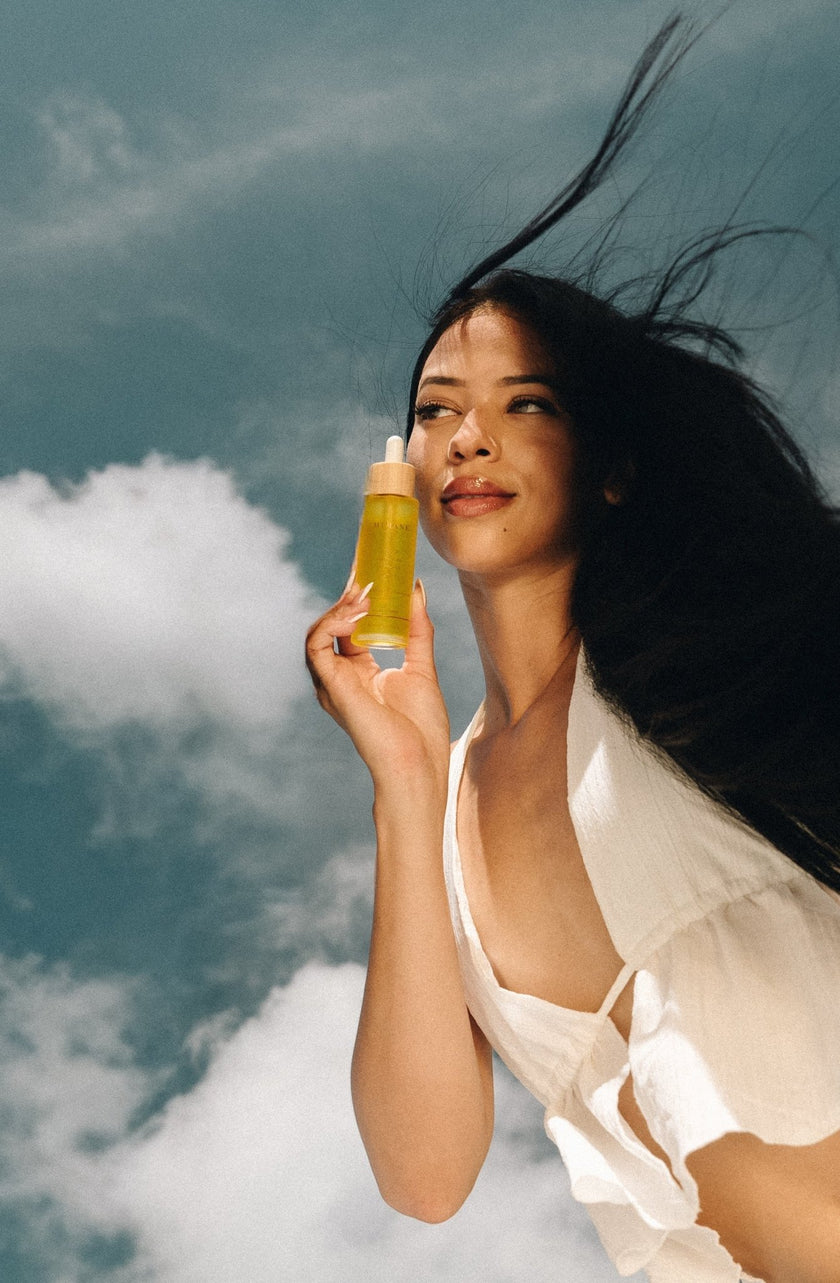
When we were building the Growth & Strengthen Hair Oil, the question wasn't "what's the trendy ingredient." It was "what's the one oil this entire formula has to be anchored in." Jojoba was the answer. Everything else in the bottle (argan, babassu, pumpkin seed, squalane, rosemary, lavender, turmeric, vitamin E) supports a specific job, but jojoba is the carrier that makes the formula sit right on curly hair instead of weighing it down.
The reasoning was simple. If the goal is a daily-friendly oil that works for curly hair without buildup, the base has to behave like sebum. Heavier oils on their own (castor, coconut) move the needle on penetration and strength but get greasy fast and aren't beginner-friendly for curly textures. Jojoba lets the formula work as a pre-wash treatment for deeper conditioning AND as a light finishing oil on dry curls without rebuilding the routine.
This is also why the oil doesn't feel like most "growth oils" on the market. Most of those are castor-heavy and require a wash to come out. Ours is built for repeat use without the buildup penalty.
How to Use Jojoba Oil on Curly Hair (Three Ways That Actually Work)
There's no single right way to use jojoba oil on curly hair. There are three that work consistently.
1. As a pre-wash oil treatment (the highest-impact method). This is the move if you're looking for deep moisture, less breakage, and a smoother detangle on wash day. Section dry hair, apply two to four pumps of Growth & Strengthen Hair Oil from mid-length to ends, and add a few drops directly to the scalp. Massage in for about 60 seconds, let it sit for 20 to 30 minutes (or up to overnight if your hair is on the drier side), then wash with Nourish & Strengthen Shampoo and follow with conditioner. Full walkthrough in our pre-wash oil treatment guide.
2. As a leave-in additive on damp curls. After conditioning, while curls are still wet and your leave-in is freshly applied, work one to two pumps through with your hands. This adds slip for finger-coiling or styling, helps the leave-in distribute evenly, and seals moisture into the strand before air-drying or diffusing.
3. As a finishing oil on dry curls. One pump, rubbed into your palms, then pressed lightly over the canopy and ends. Don't rake it through dry curls (that breaks the cast). This adds shine, tames flyaways, and refreshes the look on day two or three.
If you're newer to curly hair routines, start with method 1 once a week and method 3 as needed. Layer in method 2 once you know how your hair responds.
What to Expect After a Few Wash Days
The first time you use jojoba on curly hair, you'll usually notice softness and shine immediately, plus an easier detangle. That's the surface result.
The deeper changes show up over two to four wash days. Curls start holding moisture longer between washes. The scalp produces less excess oil, so roots stay cleaner. Frizz on the canopy calms down because the cuticle has been laying flatter and is less reactive to humidity. Breakage on the ends drops because the strand is more flexible and you're pulling through less when styling.
What you should NOT expect: a sudden, dramatic change in curl pattern, length, or density overnight. Hair responds to consistency more than intensity. The people who get the most out of any oil routine are the ones who do it weekly without missing.
Common Mistakes Curly Girls Make With Oils
A few things that quietly sabotage results.
Using too much. Curly hair often needs less oil than it looks like it needs. Start with two pumps total for medium-length hair and add only if needed. Greasy curls aren't moisturized curls.
Applying to a dirty scalp. Oiling over product buildup or dandruff traps the gunk underneath instead of nourishing the scalp. Do a proper cleanse first, especially before a pre-wash treatment.
Skipping the wash after a pre-wash treatment. A pre-wash oil treatment requires a wash. Leaving oil in unwashed for a day or two and then layering products on top is how curls get weighed down and limp.
Treating oil as a moisturizer. Oil seals moisture. It doesn't add water. If your curls are bone-dry, you need water-based hydration first (leave-in, conditioner, or a refresh spray), then oil on top. This order matters, especially for high porosity hair that loses moisture quickly.
Buying a pure jojoba bottle and expecting a full routine. Pure jojoba is great, but a formulated oil that pairs it with argan, babassu, and squalane will outperform any single oil on curly hair. The synergy is the point.
If you're comparing jojoba vs argan for your routine, we lay out where each one wins.
Who It Works Best For (And When to Pair It With Something Heavier)
Jojoba oil works for every curl pattern, but it shines most on:
- Fine to medium curly and wavy hair that gets weighed down easily
- Low to medium porosity hair that struggles to absorb heavier oils
- Curly scalps that get oily fast or feel reactive to harsh shampoos
- Anyone newer to oiling who wants a foolproof entry point
If you have very thick, coarse, or high-density coily hair, jojoba is still a great base, but you'll probably want to layer it with something heavier on the ends — a butter, or a finishing oil like castor, on top of your jojoba-based routine. The jojoba carries the moisture in. The heavier layer seals it for the long haul.
The Wrap
Jojoba oil works for curly hair because it doesn't fight the hair's structure. It moves like sebum, absorbs like sebum, and leaves curls feeling soft, defined, and clean instead of coated. That's why it's the anchor ingredient in the Growth & Strengthen Hair Oil and why it's the first oil we'd hand anyone with curls who's just starting a routine.
Try it as a pre-wash treatment on your next wash day. That's the easiest way to feel what jojoba actually does. Shop Growth & Strengthen Hair Oil →


)