

Lavender Oil Benefits for Hair: From Scalp Health to Stronger Strands
Lavender oil shows up in a lot of hair products. It's easy to assume it's there for scent and nothing else. But lavender essential oil has real research behind it, particularly for scalp health and the conditions that support healthy growth. This post breaks down what it actually does, where the evidence is solid, and how to use it in a way that gets results. Good for anyone adding oils to their routine, especially if scalp irritation, slow growth, or brittleness near the roots is part of the picture.
Lavender essential oil benefits for hair include reducing scalp irritation, inhibiting fungal and bacterial buildup, and supporting the conditions for healthy hair growth. Applied topically and diluted in a carrier oil, it may increase hair follicle activity. It works best used consistently as part of a pre-wash or scalp treatment routine, rather than as a one-time application.
What Lavender Oil Actually Does for Hair (and What It Doesn't)
Lavender oil doesn't grow hair on its own. Worth saying upfront, because a lot of content overclaims here. What it does is create better conditions for the scalp: less irritation, less microbial buildup, better circulation. That gives hair a healthier foundation to grow from.
The active compounds in lavender essential oil, primarily linalool and linalyl acetate, have documented antimicrobial and anti-inflammatory properties. Those aren't fragrance benefits. They're functional properties that matter for scalp health in specific, measurable ways.
What lavender oil won't do: it won't repair split ends, it won't thicken individual strands from the outside, and it's not a substitute for a proper moisturizing routine. It's a scalp-first ingredient. Understanding that helps you use it correctly.
Scalp Health: Where Lavender Oil Does Its Best Work
A healthy scalp is the foundation for healthy hair, and this is where lavender oil earns most of its reputation.
Dandruff, chronic itching, and scalp inflammation are often microbial in origin. The fungi associated with dandruff (Malassezia species) and common bacterial pathogens thrive on scalps that are oily, stressed, or stripped from over-washing. Lavender oil has been studied for its antifungal and antibacterial activity against exactly these kinds of pathogens.
A few specific things it does at the scalp level:
Reduces fungal and bacterial load. Lavender oil inhibits several strains of Malassezia and common skin bacteria. Less pathogen activity means less inflammation, less flaking, and a calmer scalp overall.
Soothes irritation and sensitivity. The anti-inflammatory properties apply at the skin level too. If your scalp tends to feel tender or reactive, especially a day or two after washing, lavender can help reduce that baseline sensitivity over time.
Improves circulation when applied with massage. A light scalp massage during application stimulates blood flow to the follicles. Better circulation means better nutrient delivery to actively growing hairs. The massage matters as much as the oil here. Two to three minutes of fingertip pressure is enough.
If you deal with scalp discomfort between wash days, or if buildup tends to trigger itching, lavender oil is one of the more practical ingredients to reach for.
How It Supports Stronger, Less Brittle Strands
The strand benefits from lavender oil are real, but they're mostly downstream of scalp health. Here's the direct research:
A 2016 study published in Toxicological Research found that topical lavender oil application significantly increased hair follicle count and depth in mice, outperforming control groups and performing comparably to minoxidil in some measurements. (PubMed, PMID 27123160 (opens in a new tab)) That's animal data, not a human clinical trial, so the finding is promising rather than definitive. But the mechanism, increased follicle activity and dermal thickness, explains why lavender shows up in serious hair growth formulas rather than just fragrance blends.
The strand strength connection is more indirect. Hair that grows from a healthy, well-circulated scalp tends to have better elasticity from the start. Strands that form in an inflamed or nutrient-poor environment are more prone to breakage at the root end, not just at the tips. Addressing the scalp environment is addressing strand quality before the strand even emerges. That's the logic.
How to Use Lavender Oil in Your Hair Routine
Pure lavender essential oil needs to be diluted before it contacts your scalp or hair. Applying it undiluted can cause irritation or sensitivity, particularly on a scalp that is already reactive. The standard dilution for scalp use is around 2 to 3 percent: roughly 5 to 6 drops per tablespoon of carrier oil.
Pre-wash scalp treatment: Combine 5 to 6 drops of lavender essential oil with one tablespoon of a carrier oil. Jojoba, argan, and babassu all work well. Apply to the scalp in sections with your fingertips, massage for 2 to 3 minutes, and leave on for 20 to 30 minutes before washing. This gives maximum contact time at the scalp where you want it working.
Using a pre-formulated hair oil: If your hair oil already contains lavender at the right dilution, no extra steps needed. Apply directly to the scalp before washing, massage in, and proceed with your routine. The formulation handles the ratios.
Post-wash finishing: A small amount of hair oil with lavender through mid-lengths and ends adds sheen and a light protective layer. The scalp benefits won't be as direct this way, but it contributes to a clean finish without greasiness, especially with fast-absorbing carriers like babassu and jojoba.
Consistency is the deciding factor. One use tells you almost nothing. Four weeks of regular pre-wash application gives you a real read on what it's doing for your scalp.
Why Mimane Glow Uses Lavender in the Formula
Lavender essential oil is in both the Growth & Strengthen Hair Oil and the Nourish & Strengthen Conditioner. Not for scent, though the scent is a benefit. It's there because of what it contributes to the scalp environment.
The hair oil formula was built around one idea: scalp health and strand strength are the same problem. Ingredients that address the scalp environment affect every hair that grows from it. Lavender works alongside rosemary oil, which has its own solid research behind scalp circulation and follicle support, and jojoba oil, which absorbs without sitting on top of the hair shaft. Together they create a formula that addresses root health, not just surface feel or shine.
In the conditioner, lavender's role is more about soothing scalp contact and contributing to the overall anti-inflammatory profile, alongside aloe vera juice, panthenol, and argan oil.
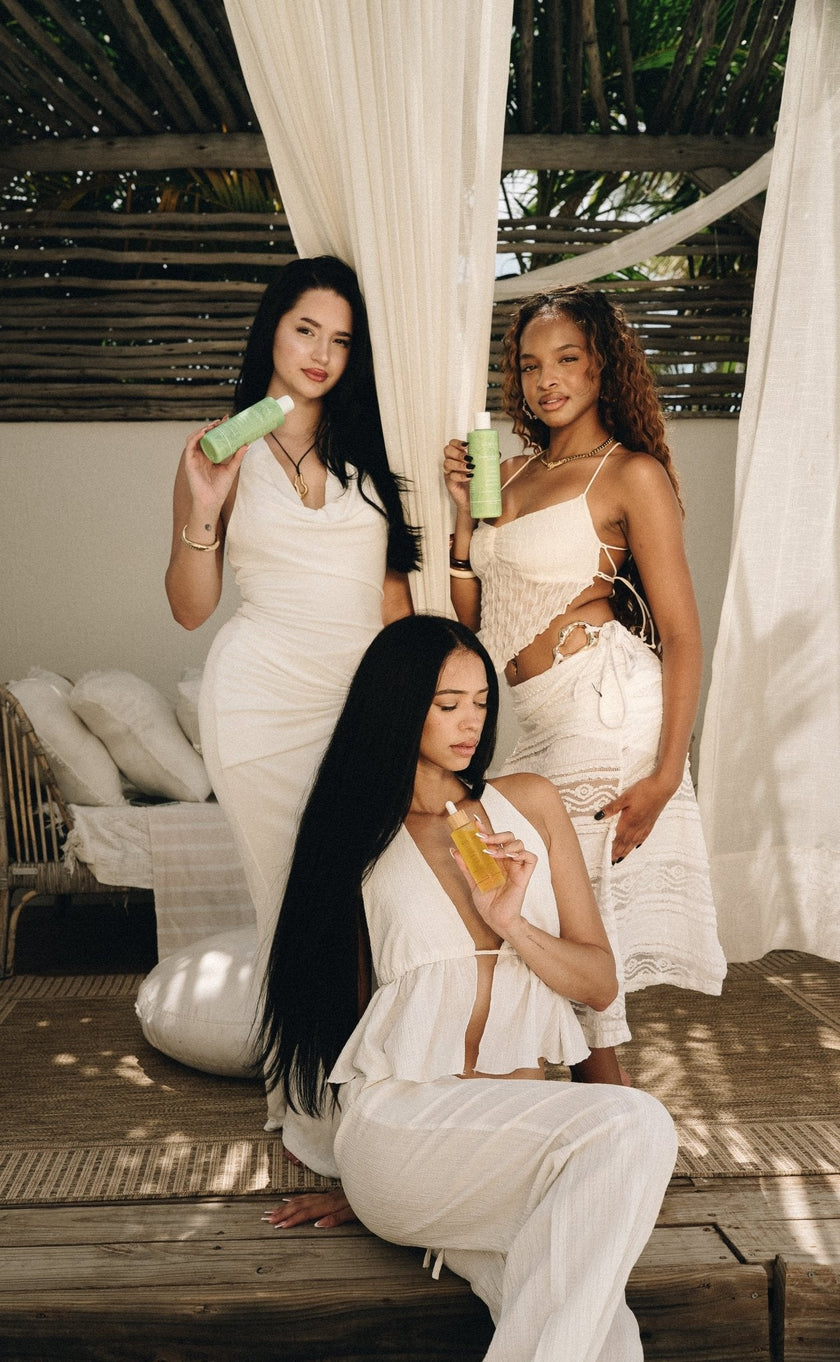
Xilenia uses the hair oil as a pre-wash treatment before every wash day. She notices it in how her scalp feels during the wash itself: less tension, less irritation when rinsing. And in how her hair behaves after drying: less static, easier to detangle, more shine without the heaviness you get from heavier oils.
What to Expect After a Few Weeks
Set realistic expectations from the start. Lavender oil works gradually, and the results tend to show up scalp-side first.
Week 1 to 2: For people with a tender or itchy scalp, this is usually the first thing that improves. Less reactivity between wash days, less urge to scratch. The scent after application is noticeable but fades within an hour.
Week 3 to 4: Scalp feels more balanced overall. Some people notice new fine hairs around the hairline or temples becoming more visible as follicle activity increases. These are usually hairs that were always there, now getting more support.
Month 2 and beyond: Strands growing in during consistent use tend to have less breakage at the roots. This is the scalp-to-strand connection playing out in a visible way. It's not dramatic, and it's not instant. But it's real if you stay consistent.
If you're using a hair oil that already includes lavender in the formula, these benefits are built into a routine step you're already doing. No additional products, no extra time.
Lavender oil earns its place in a hair routine through what it does at the scalp: reducing microbial load, calming inflammation, and supporting the circulation and follicle health that stronger strands depend on. That's a different story than most ingredient marketing tells. If scalp health or consistent growth is what you're working toward, building lavender into a pre-wash routine is a straightforward place to start. The Growth & Strengthen Hair Oil has lavender formulated alongside rosemary, jojoba, argan, and babassu. One bottle, pre-wash routine handled.
Try it in your next wash day: Growth & Strengthen Hair Oil