

You are on the third pass over the same section, the one near your face that never wants to lie flat, and the iron makes that faint hissing sound it makes when hair is not quite dry. That section is also the one you had lightened six weeks ago. Heat styling colored hair is the one place in a routine where two kinds of damage stack on top of each other, and the section you fuss over most is usually the section paying for it. This post covers the temperature rule, the one-pass method, and what to do on wash day, for anyone who colors their hair and is not willing to give up the iron.
Color-treated hair handles heat styling on tighter margins. Keep the iron between 300 and 350 degrees Fahrenheit, work only on fully dry hair, use a real heat protectant, and take one clean pass per section instead of three. Bleached or highlighted hair sits at the low end of that range. Recovery happens on wash day, not with the iron.
Why does heat hit color-treated hair harder than virgin hair?
Because color has already removed the layer that would have absorbed the heat. Permanent color and bleach both work by opening the cuticle and oxidizing what is inside, and in the process they strip away 18-MEA, the fatty acid layer that makes a healthy strand water-repellent and slippery. What is left is a rougher, more porous surface with fewer intact disulfide bonds holding the structure together.
So the same iron pass that a virgin strand shrugs off lands on a strand that is already down a layer and already holding more water inside it. Heat drives that trapped water out fast, and fast is the part that cracks cuticle.
Bleach does not just lift pigment, it takes the surface with it. That is why bleached and highlighted hair needs a lower setting than single-process color, and why a box of demi-permanent gloss is a much softer hit than a lift to level nine.
What temperature should you flat iron colored hair at?
Between 300 and 350 degrees Fahrenheit for most colored hair, and 280 to 320 for bleached, highlighted, or previously heat-damaged hair. Fine hair belongs at the bottom of whichever range applies to it. The 400 to 450 settings printed on most irons exist for coarse virgin hair and professional use, not for a strand that has been chemically lightened.
The research is blunt about what those high settings do. In a 2011 study in the Journal of Cosmetic Science, Zhou, Rigoletto, Koelmel and colleagues examined flat-iron damage using infrared imaging, calorimetry, and electron microscopy, noting that these devices operate at temperatures over 200 degrees Celsius, roughly 392 Fahrenheit, and cause significant damage to hair keratin. Their thermally stressed tresses broke significantly more during combing than untreated ones, and pretreating with film-forming polymers significantly reduced that breakage (Zhou et al., 2011, J Cosmet Sci 62(2), via PubMed).
Two things in that are worth keeping. The damage is temperature-driven, so dropping the dial is the single highest-leverage change you can make. And the protection came from a film laid down before the heat, not from conditioning after it.
There is no version of this where 450 degrees is fine on bleached hair. If your style is not holding at 330, the problem is almost always damp hair or too-thick sections, not the setting.
Does hair oil work as a heat protectant on colored hair?
No. Hair oil is not a heat protectant, ours included. Plant oils have smoke points that sit uncomfortably close to styling temperatures, jojoba around 383 degrees Fahrenheit, argan around 420, coconut around 350. Above those points an oil stops being a buffer and starts cooking on the strand, which is the opposite of the job.
What a light oil does well before the iron is add slip and cut the friction of the plates dragging through. That is a real benefit and it is why applying a drop or two before the flat iron works, as long as the hair is bone dry, the oil has a minute to absorb, and the iron stays under 350. It is slip, not shielding.
Actual heat protection comes from film-forming polymers and high-boiling esters, the ingredient families in the Zhou study. That is a different product category from a botanical oil, and it is worth owning a real one if you flat iron colored hair regularly. We are working on a silicone-free version, though it is not finished and we are not making claims for it yet.
What does a safe heat styling routine for colored hair look like?
Six steps, in this order, and the order matters more than any single product.
- Wash gently, not often. Sulfate-free cleansing and fewer washes both slow color fade. How often depends on your scalp and your color, and how often to wash color-treated hair breaks the schedule down.
- Condition every wash, no exceptions. Porous colored hair loses water faster than it takes it in. Conditioner is what closes the cuticle back down before it ever meets an iron.
- Apply heat protectant to damp hair, root to ends, and comb it through so the film is even. Patchy application means patchy protection.
- Dry completely. Ironing damp hair turns trapped water into steam inside the strand, and that is where the hissing and the little crunch come from. This is the most common cause of avoidable heat damage on colored hair.
- One pass per section, thin sections. Take sections about an inch wide. One slow, continuous pass at 320 beats three rushed passes at 400, every time. If you need a second pass, your section is too thick.
- Finish with a drop of oil on the ends only, after the iron is off and the hair has cooled. This is where an oil earns its place.
The tell that you got it right is what is not on the sink afterward. Fewer short broken pieces on the white porcelain, less of that hollow feeling at the ends when you run your fingers down a section.
How often can you heat style color-treated hair?
Once or twice a week is a reasonable ceiling for most colored hair, and once a week for bleached hair. Heat damage is cumulative in a way color damage is not, because each pass costs a little more cuticle and none of it grows back on the strand you already have.
The honest version of this is that frequency matters more than technique. Perfect technique five days a week will still out-damage sloppy technique once a week. If you are styling daily right now, cutting to three days and learning one good air-dry or heatless method for the others does more for your ends than any product swap.
If your ends are already rough, chewy when wet, and splitting faster than you can trim, start with the realistic routine for repairing heat-damaged hair before you add heat back in. Bleached hair specifically has its own recovery arc, covered in bringing bleached hair back to soft.
How Mimane Glow fits into heat styling colored hair
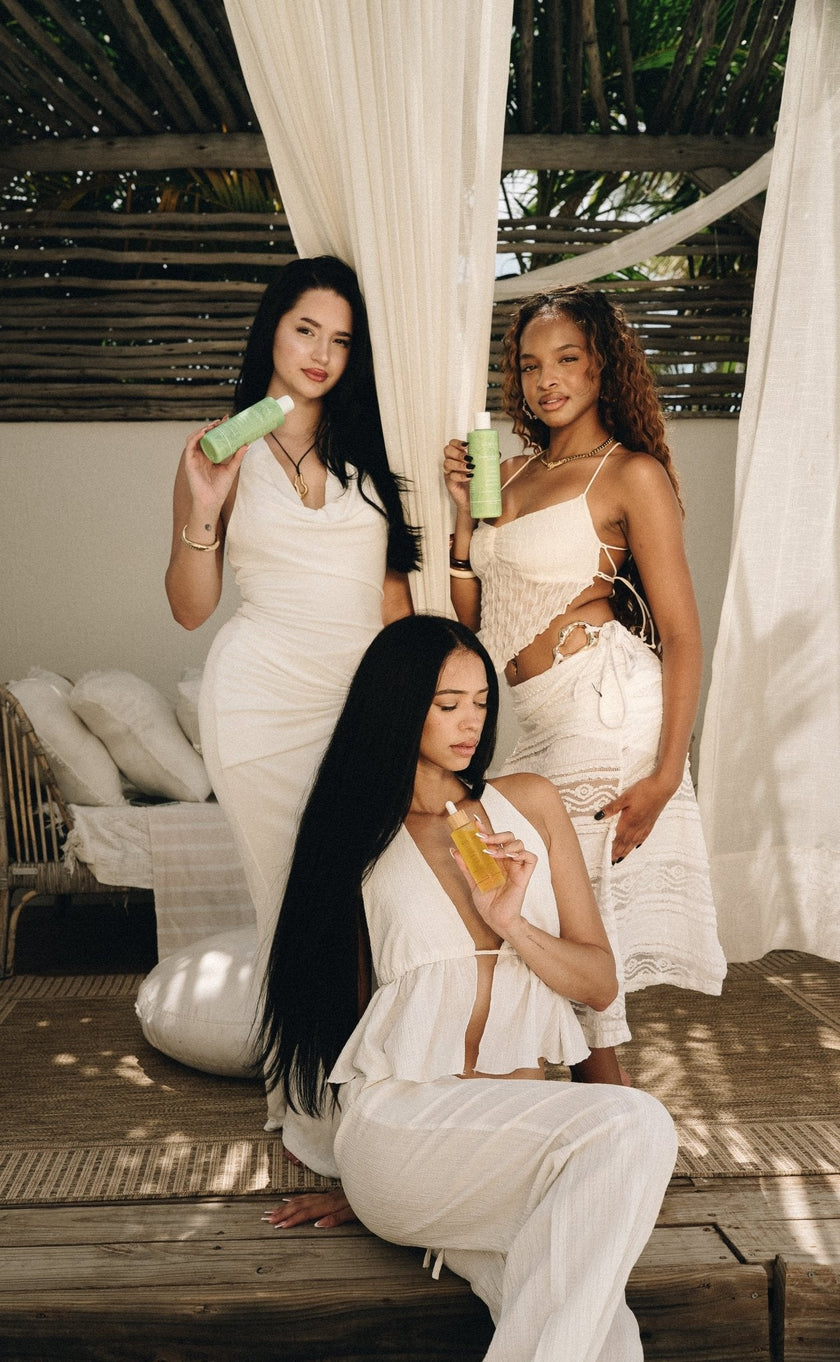
Our role in this is the wash day around the heat, not the heat itself. The Nourish & Strengthen Duo is built for exactly the gap color leaves behind: the shampoo is sulfate-free with water first and aloe vera juice right behind it, plus panthenol and hydrolyzed silk protein, and the conditioner carries hydrolyzed keratin alongside shea butter, argan, and pumpkin seed. Protein for the structure bleach took, cationic conditioning to lay the cuticle flat again. All three products are sulfate-free, silicone-free, and free of mineral oil, which matters when your goal is keeping color in rather than stripping it out.
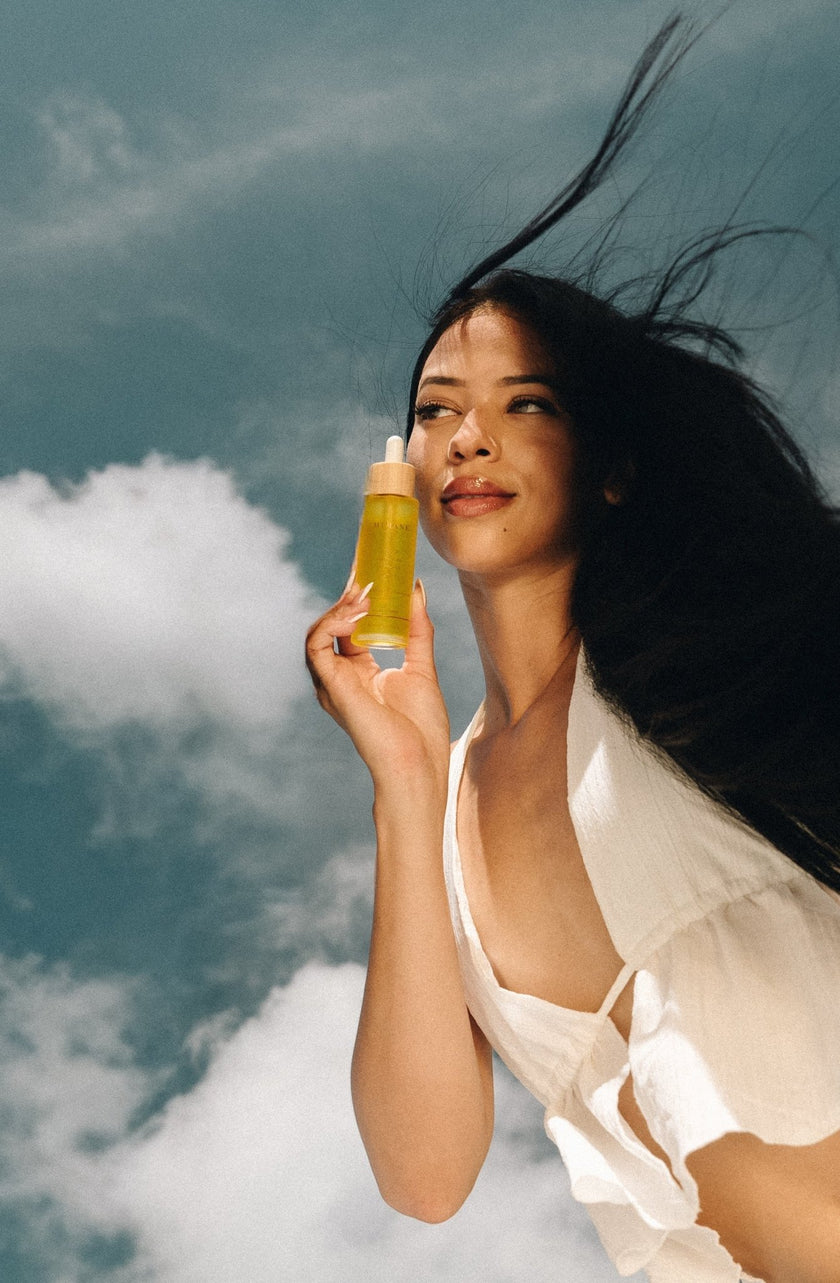
The Growth & Strengthen Hair Oil earns its place on either side of a heat day, not during it. The Glow Complex blends jojoba, argan, babassu, and pumpkin seed with squalane, turmeric extract, rosemary, lavender, and vitamin E, and we chose jojoba and squalane as the lead lightweight oils specifically because they absorb instead of sitting on top, which is what makes them usable near heat at all. It comes with a dropper because two drops is the correct dose and a pump is not.
Here is what we tell every customer who colors and irons: the iron temperature is the decision that matters, and everything we sell is support around it. Drop the dial to 320, fix the drying, and give it three wash days. If your ends still feel hollow after that, the problem is frequency, and no bottle fixes frequency. We would rather say that than sell you a routine that quietly depends on you never touching an iron. The full comparison of what to look for in a color-safe oil lives in our guide to the best hair oil for color-treated hair.
Frequently asked questions
Does heat styling make hair color fade faster?
Yes. Heat opens the cuticle and accelerates pigment loss, and reds and fashion tones fade fastest. Lowering the temperature and styling less often both slow fade measurably, usually within the first two or three weeks.
How long should I wait after coloring before I flat iron?
Give it about 72 hours. The cuticle stays swollen and the color molecules keep settling for a couple of days after processing, so heat in that window costs you both tone and structure.
Is a blow dryer safer than a flat iron on colored hair?
Generally yes, because a dryer works at a distance with moving air rather than pressing metal directly onto the strand. Keep it six inches away, on medium heat, and finish the last twenty percent on cool.
Can I use a heat protectant and hair oil together?
Yes, in that order and in small amounts. Protectant on damp hair first, dry completely, then one drop of oil on mid-lengths and ends if the hair still feels rough. Layering both heavily is where buildup and plate transfer start.
Do I need a lower temperature for highlights than for all-over color?
Yes. Highlighted and balayage pieces have been lifted further than the rest of your hair, so they are the most fragile strands on your head. Set the iron for those pieces, not for your natural base.
My hair smells faintly burnt after ironing. What does that mean?
It means the temperature is too high, the hair was not fully dry, or both. Drop the setting by 30 degrees and check that your hair is completely dry before the next pass.
The bottom line on heat styling colored hair
Heat styling colored hair works when you treat the temperature dial as the main decision and everything else as support. Stay between 300 and 350, lower if you are bleached, dry completely, one pass per thin section, and keep a real heat protectant in the rotation. Then let wash day do the recovery. If you want the whole routine pulling the same direction, the Glow Kit pairs the gentle cleanse and conditioner with the oil for the finishing step, once the iron is off.