


You ran the flat iron through the same section twice because the first pass did not take, and now there is a piece near your temple that will not lie down with the rest of your hair. The signs of heat damaged hair show up like that, one at a time, months after the styling that caused them. Each sign has a different answer. Some you can walk back with a routine change, and one of them is a trim no product will save you from. Here is how to read each one.
The main signs are dryness that conditioner no longer fixes, short pieces snapping mid-strand, split ends traveling up the shaft, curls or waves gone flat in patches, a rough texture that will not hold shine, and ends that read lighter than your roots. Moisture and protein routines help most of them. Lost curl pattern and advanced splits need cutting.
What does heat actually do to a strand?
Heat drives water out of the hair and softens the proteins that hold its shape, and when the strand cools it sets in whatever position the iron left it. Most flat irons and curlers run somewhere between 300 and 450F. At the top of that range you are working close to the temperature where keratin stops behaving like keratin.
The moisture loss is measurable. In a 2011 study in Annals of Dermatology, Lee and colleagues put hair tresses through thirty rounds of washing and drying, comparing natural air drying against a dryer held at a series of increasing temperatures, and looked at the surface under electron microscopy afterward. Surface damage climbed as the temperature climbed, and every heat-dried group finished with lower moisture content than the untreated control (Lee et al., 2011, Annals of Dermatology, 23(4):455-462 (opens in a new tab)). Thirty rounds is roughly a month of wash days for most people.
That is the part worth sitting with. The damage is cumulative and it is quiet. You do not feel one blow-dry, you feel the sixtieth.
Sign 1: Dryness that conditioner no longer fixes
If your hair feels dry an hour after a full wash-and-condition, the problem is usually that it cannot hold water anymore, not that your conditioner is too light. Heat lifts and chips the cuticle, which is the shingled outer layer that normally slows water moving in and out. Once it is compromised, water floods in fast and leaves just as fast.
This is the most fixable sign on the list. The fix is a protein and moisture rhythm rather than more conditioner: protein to fill the gaps in the surface, moisture to sit behind it, and a pre-wash oil so the strand is not starting every wash day bare. If you are not sure which one your hair is asking for, the protein versus moisture read is the test to run first.
One honest note on timing. The strand you are treating stays damaged. What improves is how it behaves day to day, and that improvement arrives within a few wash days, not months.
Sign 2: Short pieces snapping mid-strand
Short broken pieces are the sign to act on fastest, because unlike the others it is still spreading. Look for a halo of inch-long pieces at your crown, layers you never asked a stylist for, and snapped hairs in your brush with no white bulb at the root. A shed hair has that little bulb. A broken hair does not.
Heat breakage tends to land mid-strand rather than at the tips, because the middle of the hair is where the iron plates spend the most time and where a comb pulls hardest. Thermal and mechanical damage stack in the same inch.
The fix is subtraction before addition. Drop the heat, cut the passes to one, detangle with conditioner in and a wide-tooth comb rather than dry with a brush, and let the snapping stop before you judge any product. We walked through the other five causes in why hair breaks off, and heat rarely acts alone.
Sign 3: Split ends climbing up the strand
This one is a trim. A split end is the cuticle gone and the cortex unraveling into two, and nothing on a shelf fuses it back together. Products can smooth the look of a split and slow the next one, which is worth doing, and that is where their job ends.
What makes splits urgent instead of cosmetic is that they travel. A split that starts at the tip keeps unzipping upward while you brush and style, so waiting six months to deal with half an inch usually costs you two inches. Cut above the split, then protect what is left.
If your ends feel like dry thread between your fingers and you can see white dots along the length, book the trim. That verdict has not changed in the time we have been writing about hair, and we would rather say it plainly than sell you something.
Sign 4: Curls or waves gone flat in patches
Run water over the flat section. Healthy curl and wave pattern comes back when it is soaking wet, every time. A heat-damaged section stays limp under the tap, and that is the clearest home test there is for heat training.
Heat training is what happens when repeated high heat permanently relaxes the disulfide bonds that give a strand its curl. For those specific strands, it is done. There is no mask, bond builder, or protein treatment that re-curls hair that has lost its pattern to heat, and anything promising otherwise is describing a temporary cosmetic effect.
The honest plan is a long one. Stop heating those sections, keep the new growth protected so the pattern grows in intact, and take the straight ends off gradually over a year of trims. Plenty of people live happily with a slightly looser pattern. The goal is to stop it spreading into the rest of your hair.
Sign 5: Rough, grabby texture that will not take shine
Hair that catches on your fingers and looks dull in every light has a lifted cuticle scattering light instead of reflecting it. Shine is a surface property. When the shingles lie flat, light bounces in one direction and reads as gloss. When they are raised and chipped, it scatters.
Good news on this one: it responds to conditioning faster than any other sign here, because you are flattening the surface rather than rebuilding it. A conditioner with real cationic conditioning and protein, finished with a few drops of oil on the mid-lengths and ends, will change how hair looks and feels the same day.
The grabby feeling is also an early warning. Texture roughens before anything snaps, so hair that has started catching on itself is telling you the breakage stage is next if the routine does not change.
Sign 6: Ends that read lighter or brassier than your roots
Ends that have drifted lighter or warmer than your roots without any new color in them have been heat-lifted, and it points to deeper damage than the color itself. High heat degrades the pigment inside the strand along with the structure around it, which is why the shift always shows up at the oldest, most-styled inches first.
The 2011 Annals of Dermatology work above picked this up as well: color lightened measurably in the hottest drying conditions after only ten treatments, well before anything looked broken.
If your hair is colored, the effect compounds, because lightener has already thinned the cuticle that heat then has to pass through. That combination has its own rules, and we laid them out in heat styling color-treated hair without the double damage. Tonal shift from heat cannot be conditioned back, so this is a gloss or toner conversation with your colorist, plus lower heat going forward.
How do you tell the signs of heat damaged hair from plain dryness?
Three tests separate them, and you can do all three in a bathroom in two minutes. Wet a section: a curl pattern that returns when wet is dry, not heat-damaged. Look at the hairs in your brush: white bulb means shedding, no bulb means breakage. Run your fingers from mid-shaft to tip: dryness feels uniformly thirsty, while heat damage feels normal up top and like thread at the ends.
The location tells you most of it. Dryness is usually all over and tied to your water, your cleanser, or your climate. Heat damage is concentrated in the sections you style most, which for most people means the front, the crown, and the last three inches.
How do you stop it from spreading?
Lowering the temperature and cutting the number of passes does more than any product you can buy. In order of how much they matter:
- Use the lowest setting that works, and go once. Two passes at a lower temperature is gentler than one at maximum, and re-ironing a section that did not take is where most damage actually happens.
- Get hair to about 80 percent dry before any iron touches it. Water inside a strand under hot plates turns to steam and pushes out through the cuticle from the inside.
- Put a product built for heat between the plates and your hair. This is the step most routines skip, and it is the one we are formulating next. Until it lands, use a heat protectant you already trust.
- Use oil where it belongs. A few drops through mid-lengths and ends before styling adds slip and cuts the friction of the pass, and the technique matters more than the amount. We broke down the method in applying hair oil before the flat iron without buildup.
- Change what you can skip. Air dry on two days a week, stretch your style an extra day with a silk scarf, and accept a style that is 90 percent as sleek.
How Mimane Glow approaches heat-damaged hair
We built the routine around retention, which means keeping the length you already grew rather than promising to undo what the iron did. The Nourish & Strengthen Conditioner carries hydrolyzed keratin and hydrolyzed silk protein alongside shea butter, argan, babassu, and pumpkin seed oils. The two proteins are there for exactly this situation: small enough to settle into the gaps heat leaves in the cuticle, which is what brings back slip and cuts the force your comb needs on wash day.
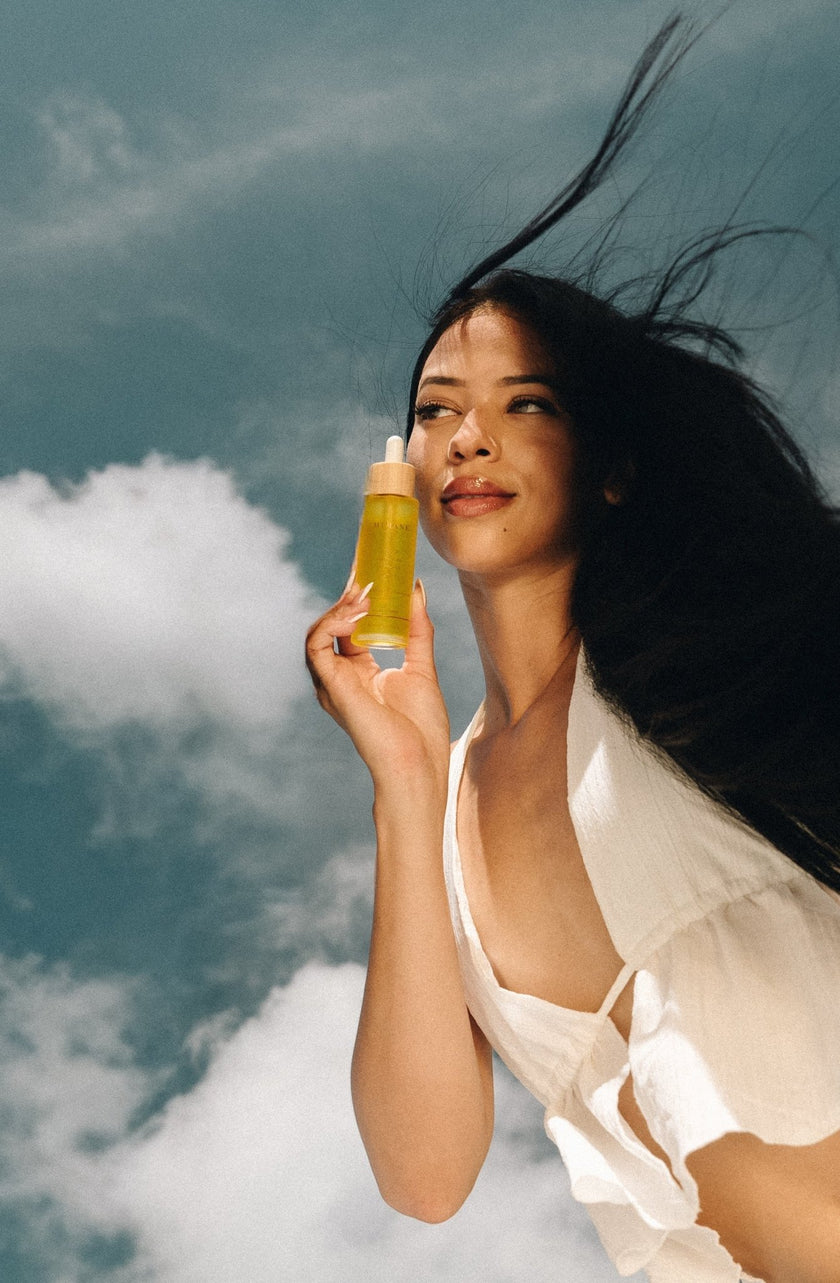
The Growth & Strengthen Hair Oil does the friction half of the job. The Glow Complex blends jojoba, argan, babassu, and pumpkin seed with squalane, turmeric extract, rosemary, lavender, and vitamin E, and it absorbs fast enough to use as a pre-wash treatment every few days without buildup. It arrives with a dropper because a few drops is the correct dose on damaged ends.
Here is what we tell every customer who writes in about heat damage. Give it six weeks of a lower-heat routine before you judge anything, and book the trim you are avoiding in week one, because a rebuild routine run on top of splits that are still traveling is money spent against itself. For the full version of that routine, our realistic routine for heat-damaged hair walks through the order.
Frequently asked questions
Can heat damaged hair be repaired without cutting it?
Partly. Softness, shine, slip, and breakage are all manageable with a protein and moisture routine, but split ends and lost curl pattern are structural and need to be cut off.
What temperature is safe for flat ironing?
Lower than most people use. Fine, bleached, or color-treated hair does better under 300F, coarse hair can need more, and the number of passes matters as much as the dial.
How long before my hair feels better after I stop heat styling?
Feel improves within two or three wash days once conditioning is consistent. Genuinely undamaged hair has to grow in, which at roughly half an inch a month is a year-long project.
Does air drying prevent heat damage?
It removes the heat, which is the main variable. Worth knowing that the 2011 Annals of Dermatology study found the naturally dried tresses were the only group with damage to the cell membrane complex, so leaving hair soaking wet for hours has its own small cost. Rough dry on low, then let it finish in the air.
Can I use hair oil on heat damaged hair?
Yes, and damaged ends are where oil earns its keep most. Use it as a pre-wash treatment on the lengths and a few drops on dry ends after styling.
Is heat damage worse on color-treated hair?
Yes. Lightening and coloring already thin the cuticle, so the same iron temperature does more harm, and the signs tend to show up months earlier.
The bottom line
The signs of heat damaged hair sort into two piles. Dryness, roughness, dullness, and mid-strand breakage respond to a lower-heat routine with protein and moisture behind it. Split ends and a curl pattern that stays flat when wet are a trim, and the sooner the better. Read your own hair honestly, then protect what you keep. The Glow Kit is the simplest way to get the cleanse, the protein, and the oil working in the same direction.




)