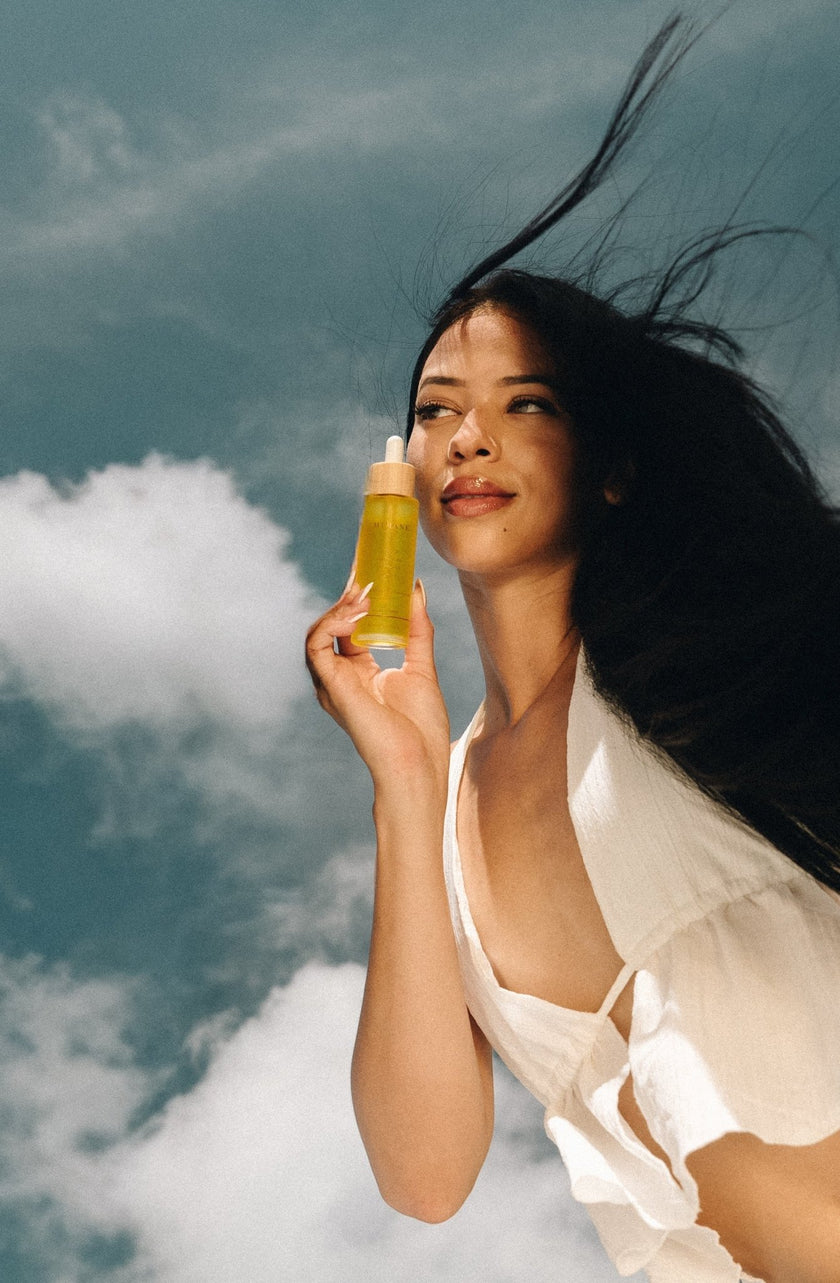


If you just colored your hair and you have been seeing rosemary oil all over your feed, the worry is fair. You spent money on that color, and the last thing you want is an oil that fades it in two washes. The short version: rosemary oil is safe for color-treated hair when it is properly diluted and used as a scalp or pre-wash treatment. This guide covers when it helps, when it can cause problems, and exactly how to use it on dyed or highlighted hair.
Quick answer: Yes, rosemary oil is generally safe for color-treated hair. Diluted in a carrier oil or used inside a finished hair oil blend, it sits on the scalp and strands without stripping dye, because it contains no sulfates, no peroxide, and no harsh solvents. The main caveats: never apply undiluted essential oil, patch test first, and wait 48 to 72 hours after coloring.
Does rosemary oil fade or strip hair color?
No, rosemary oil does not strip hair color the way a clarifying shampoo or repeated high heat can. Color fades for two reasons: the cuticle stays open and dye molecules rinse out over time, or something chemically lifts the pigment. Rosemary oil does neither.
Oils actually work in your favor here. A thin layer of oil helps smooth the cuticle and slows the water-driven fade that happens every wash day. The real fade culprits are sulfate-heavy or clarifying shampoos, hot water, sun, and chlorine, not a diluted plant oil sitting on your strands. If you want the full breakdown of which oils are safe and which are not, we covered it in does hair oil fade color.
What makes rosemary oil color-safe, and when is it not?
Rosemary oil is color-safe because it has none of the chemistry that lifts or strips dye. There is no ammonia, no peroxide, and no sulfate in the oil itself, so it cannot open the cuticle and pull pigment out. On its own, it is one of the gentler things you can put near color-treated hair.
It stops being a good idea in three situations. First, using the pure essential oil undiluted, which risks scalp irritation, not color loss. Second, applying it too soon after a color service, before the cuticle has fully closed. Third, using a cheap blend that pairs rosemary with clarifying agents or drying alcohols, which can fade color on their own. The rosemary is rarely the problem. What it is mixed with usually is.
Should you use a diluted essential oil or a ready-made oil blend?
For color-treated hair, a ready-made oil blend is the easier and safer choice. Pure rosemary essential oil is potent and has to be diluted to roughly 1 to 2 percent in a carrier oil like jojoba before it touches your scalp. Get that ratio wrong and you can irritate the skin, even though your color stays fine.
A formulated hair oil takes that math off your plate. The rosemary is already diluted to a safe level and balanced with carrier oils chosen to absorb cleanly. If you would rather mix your own, stick to a known dilution and a lightweight carrier so you are not weighing colored strands down. Either way, the goal is the same: enough rosemary to feel the scalp benefit, never so much that it stings.
How do you use rosemary oil on color-treated hair, step by step?
Use rosemary oil as a pre-wash scalp and lengths treatment once or twice a week. That timing keeps the scalp comfortable and the strands soft without leaving buildup on colored hair. Here is the routine:
- Patch test first. Put a small amount behind your ear or on your inner arm and wait 24 hours. This matters more for sensitive scalps than for your color.
- Start at the scalp. Part your hair in sections and apply a few drops of diluted oil along each part. Massage with your fingertips for two to three minutes.
- Take it through the lengths. Smooth whatever is left on your hands down the mid-lengths and ends, where color-treated hair tends to feel driest.
- Let it sit. Leave it on for 20 to 30 minutes, or overnight with a silk scarf or pillowcase if you want a deeper treatment.
- Wash it out gently. Rinse with a sulfate-free shampoo so you are not undoing the point of the treatment by stripping color on the way out.
If you want the version built specifically around protecting dye, our color-treated hair routine walks through the full wash day. For a refresher on getting color to last between washes, see how to keep hair color from fading.
What does the research actually say about rosemary oil?
The research on rosemary oil is about the scalp, not about color. A 2015 randomized comparative trial published in the journal SKINMED followed 100 people with pattern hair loss over six months and compared rosemary oil to 2 percent minoxidil, a common over-the-counter scalp treatment. Both groups saw comparable changes in hair count by the end, and the rosemary group reported less scalp itching (Panahi et al., 2015, PubMed).
That study is why rosemary is having a moment, and it is worth being honest about what it shows and what it does not. It tested rosemary applied to the scalp for density and comfort. It says nothing about hair color, and we are not claiming an oil grows your hair. What rosemary reliably brings to a routine is scalp comfort, and that is the lane we care about. If you want the deeper look at the trend itself, we wrote it up in rosemary oil for hair growth: the truth behind the trend.
Why Mimane Glow includes rosemary in the Growth & Strengthen Hair Oil
We included rosemary in the Growth & Strengthen Hair Oil for the scalp, and we diluted it the way the research uses it, not at a strength that stings. It sits in a base of lightweight carrier oils like jojoba that absorb without coating, so colored hair gets softness and shine without a greasy film.
The formula is free of mineral oil and harsh solvents, which is the part that matters for dyed hair. That is a deliberate choice, not a marketing line. An oil that cannot strip color lets you get the scalp benefit of rosemary and the moisture of the carrier oils while your color stays where you put it. The result most people notice is softer, shinier, less brittle strands and a calmer scalp, which is exactly what color-treated hair tends to be missing.
Common mistakes to avoid with rosemary oil on dyed hair
Most rosemary oil problems come down to how it is used, not the oil itself. Skip these and you are in good shape:
- Using it undiluted. Pure essential oil belongs in a carrier, never straight on the scalp.
- Applying it right after coloring. Give freshly colored hair 48 to 72 hours so the cuticle can close first.
- Skipping the patch test. Sensitive scalps can react to essential oils even when color is fine.
- Choosing a blend with clarifiers or drying alcohol. Those ingredients fade color, and people blame the rosemary.
- Overdoing it. Once or twice a week is plenty. Daily heavy application leaves buildup on color-treated lengths.
Frequently asked questions
Can I use rosemary oil right after coloring my hair?
Wait 48 to 72 hours. The cuticle is still settling right after a color service, so giving it a couple of days lets the dye lock in before you add any oil.
Will rosemary oil affect blonde or highlighted hair?
High-quality, steam-distilled rosemary oil is nearly colorless and will not tint light hair. Cheaper oils can carry a slight tint, so patch test on a hidden section first if you are platinum or have fresh highlights.
How often should I use rosemary oil on color-treated hair?
Once or twice a week as a pre-wash treatment is the sweet spot. That is enough for scalp comfort and softness without leaving buildup on colored strands.
Is rosemary oil safe for keratin-treated or chemically straightened hair?
Generally yes, as a gentle scalp and pre-wash treatment. Avoid aggressive scrubbing or massaging that could disturb the treatment, and always rinse with a sulfate-free shampoo.
Can I mix rosemary oil with other oils?
Yes. Layering it into a carrier like jojoba or argan is the standard way to use it, or you can reach for a finished blend where the dilution is already handled for you.
Does rosemary oil work on all hair types with color?
It suits most hair types. Fine or low-density hair should use a few drops and keep it mostly on the scalp, while thicker hair can take it through the lengths too.
So, is rosemary oil safe for color-treated hair? Yes, as long as it is diluted and used as a scalp or pre-wash treatment rather than a leave-in soak right after coloring. Treat it as a weekly ritual for a calmer scalp and softer ends, and your color stays exactly where you want it. If you would rather skip the mixing and dilution math, the Glow Kit pairs the rosemary-infused hair oil with a sulfate-free shampoo and conditioner, which is the easiest way to keep color-treated hair soft and protected on wash day.